




Immunisation is not just a service — it is a promise we make to every child. India backed this promise in the second half of the last century with the launch of the Universal Immunisation Programme in 1985, now considered one of the largest public health initiatives globally. Through this programme, the country has achieved remarkable progress, with full immunisation coverage reaching 98.4% in 2026, as per Ministry of Health and Family Welfare.
The program has successfully eliminated polio, maternal and neonatal tetanus, and yaws, while protecting 2.9 crore pregnant women and 2.54 crore infants every year against 12 preventable diseases.
In a city that grows and moves constantly, one of the key challenges that health systems confront is to keep track of children when they migrate and to ensure that they continue to receive essential vaccinations on time. Frequent movement, changing settlements, and gaps in documentation often make continuity of care difficult. As a result, many children living in urban informal settlements fall out of routine tracking systems, increasing the risk of missed or delayed immunisation.
The families who live here are predominantly young, many with newborn children, constantly on the move to make ends meet. In this cycle of migration and survival, one critical need is inadvertently overlooked: the immunisation of their children.
Our (Azim Premji Foundation) journey working with the communities who live in Bellandur, in Bangalore, began in 2022, during the COVID-19 pandemic—a time when the importance of healthcare as an essential service became more visible than ever before. We initiated the health program in urban Bangalore to respond to the urgent needs emerging within vulnerable urban settlements. In Bellandur area, this was done in partnership with Gubbachi, an organisation with a long-standing presence in community-based work, particularly in education and social entitlements.
What began as an emergency response gradually evolved into a sustained effort to strengthen last-mile healthcare access. Over time, the programme expanded beyond immediate pandemic-related support to building continuous community engagement, improving linkages with the public health system, and bringing essential healthcare services closer to where people live.
Life on the margins
Due to frequent movement of families and rapidly changing settlement patterns, the local public health system often faces challenges in continuously updating and maintaining accurate beneficiary lists.
Bellandur’s settlements are home to thousands of migrant families, primarily from eastern parts of the country. They mostly work in the informal sector and live in dense, un-notified settlements, often in small tin structures with limited access to basic services. The families who live here are predominantly young, many with newborn children, constantly on the move to make ends meet. In this cycle of migration and survival, one critical need is inadvertently overlooked: the immunisation of their children.
Frequent migration poses a significant challenge to continuity of immunisation. Many families either carry incomplete records from their native places or have no documentation to continue the schedule in the current location. Due to frequent movement of families and rapidly changing settlement patterns, the local public health system often faces challenges in continuously updating and maintaining accurate beneficiary lists. As a result, many children from migrant communities are left out of line lists, leading to gaps in immunisation.
For the community, these challenges are compounded by limited understanding of immunisation, unfamiliar language, and limited understanding of the local health system. Even when parents want to vaccinate their children, many are unsure where to go or how to access the services available to them.
As Babli Das, who works as a Community Health Associate in the area told us, “As I walked through the communities of Bellandur for the first time during the COVID-19 pandemic, I realized something important — the programme exists. But not every child is reached”.
Our journey: from crisis to continuity
It became clear that the public system needed support to consistently reach these families — and our understanding and presence in the communities could help bridge the gap.
Building trust was central to this effort. Families were reassured that vaccines are free and that services were available to them. Continuity of care was maintained through persistent follow-up, even when families moved.

With this understanding, we developed a comprehensive intervention to help ensure that no child was left out of the system. Working closely with the community and the public health system, we began with door-to-door mapping to identify every household, pregnant woman, and child. From this, we created community-level line lists for families missing from official records and regularly shared this data with ANMs (Auxiliary Nurse Midwifes) and PHCs (Primary Health Centres) so that all children could be included in immunisation micro-plans. Continuous tracking and follow-up helped update due lists and ensure that children received pending vaccinations.
Building trust was central to this effort. Families were reassured that vaccines are free and that services were available to them. On immunisation days, our frontline health workers — Community Health Associates — supported families through reminders, accompaniment, and on-site facilitation, helping bridge the gap between communities and providers. Continuity of care was maintained through persistent follow-up, even when families moved.
What change looks like
Through joint planning, community mobilization, line listing, follow-up visits, and on-ground coordination during sessions, these initiatives have helped ensure that essential vaccines reach children who are otherwise difficult to track within rapidly changing urban settlements.
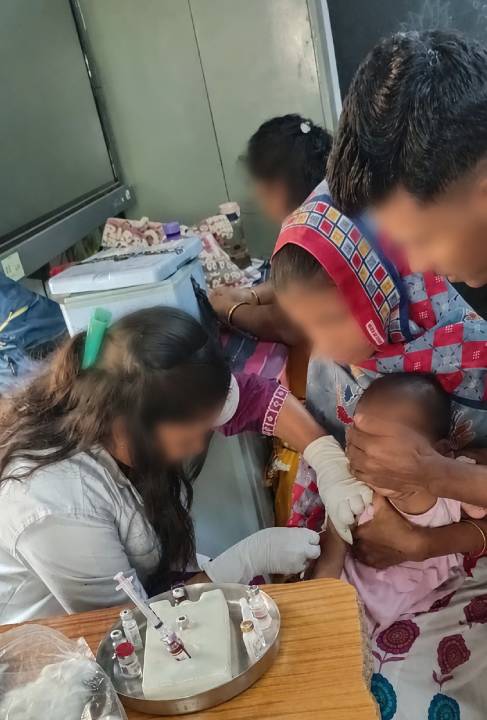
Over time, continuous coordination and relationship-building with PHC teams, ANMs, and other frontline workers has strengthened trust, improved communication, and enabled more regular planning of immunisation activities. As a result, the number of immunisation sessions conducted in these settlements has increased significantly to more than four sessions per month. Each session now reaches approximately 40–50 children, ensuring that a larger number of children — especially those from migrant and underserved families — can access routine immunisation services closer to their communities.
Subscribe to stay connected
We will send you a monthly newsletter listing all the articles that were published in the month.
These improvements also reflect a convergence between community-level efforts and the local public health system, contributing to better continuity of care and follow-up. This collaborative approach has strengthened last-mile outreach efforts, particularly in migrant and underserved settlements where children are often missed from routine coverage. Through joint planning, community mobilization, line listing, follow-up visits, and on-ground coordination during sessions, these initiatives have helped ensure that essential vaccines reach children who are otherwise difficult to track within rapidly changing urban settlements.
The communities are now better integrated and more familiar with the vaccination process. ANMs and CHAs work closely to identify eligible children, mobilize families, and include newly arrived households in the system. Regular immunisation camps are now held at the Anganwadi centre in Bellandur, where children receive vaccines each month. Their status is updated in the Thayi card (as the Mother and Child Protection card is referred to in Karnataka) and our records, enabling timely follow-up for future doses. This has also led to a visible change in the attitude of parents towards immunisation. As one Community Health Associate shared, “When we go door to door, parents feel relieved. Now they come for immunisation without fear.”