





Introduction
In India, the government is responsible for the protection and improvement of public health. Successive Supreme Court judgments have expanded the right to life under Article 21 of the Constitution to include the right to timely, affordable, and accessible healthcare. Realisation of this right depends on the quantum of government investment in the health sector and the utilisation of these funds. Public spending shapes every aspect of the health system from disease control and infrastructure to the availability of medicines, diagnostics and human resources. As per the latest National Health Accounts, this spending has helped reduce out of pocket health expenditure of households from 64% to 43% between 2013-14 and 2022-23. Hence, examining how and where resources are directed provides insight into policy priorities.
In practice, the union government sets policy priorities, and also allocates funds for health, with most health programmes being designed at the national level. These programmes are then implemented by state governments.
This four-part series examines how resources to combat communicable and non-communicable diseases are allocated by the Union government, and what this reveals about shifting health priorities. This blog, the first in the series, introduces India’s health financing architecture, the role of the Ministry of Health and Family Welfare (MoHFW), and key trends in union government expenditure. It also introduces the National Health Mission (NHM), India’s flagship programme for strengthening health services, which will be explored in greater detail in the next article
Though health is a state subject, the union budget matters
India’s federal system divides responsibilities between the union and state governments. ‘Public health, hospitals and dispensaries’ is included in the state list, making state governments primarily responsible for health services; however, several related areas fall under the concurrent1 and union2 lists. In practice, the union government sets policy priorities, and also allocates funds for health, with most health programmes being designed at the national level. These programmes are then implemented by state governments.
Health is a key part of the union government’s policy agenda. In the Union Budget 2026-27, several of the Finance Minister’s announcements were focused on strengthening the country’s health workforce and mental health infrastructure by upgrading/ establishing institutions to train allied health professionals, and creating new national level mental health institutes (NIMHANS). Hence, despite being a state subject, the union government is focused on the health sector which influences how it shapes and finances programmes.
Who manages the union budget for health?
At the union government level, the MoHFW is the nodal ministry responsible for shaping health policy, financing major health programmes, coordinating with state governments, and overseeing a range of national institutions. Though state governments deliver health services, the MoHFW sets priorities and channels resources to states. Functions are carried out through two departments: the Department of Health and Family Welfare (DoHFW), and the Department of Health Research (DHR):
- DoHFW accounts for the vast majority of the Ministry’s expenditure. It is responsible for implementing major health programmes/ schemes, supporting activities related to disease prevention, health promotion and primary healthcare, and also oversees autonomous institutions/ regulatory bodies to maintain minimum standards.
- DoHR strengthens medical and public health research in the country by generating evidence that can inform health policy and programmes.
Together, these two departments reflect the dual role of the Union Government in health: financing and supporting the delivery of services on the one hand, and generating the research and evidence needed to improve health service delivery on the other.
What do recent trends in the union budget reveal?
The Union budget provides three important measures of government spending. The budget estimates (BEs) reflect the amount initially allocated at the beginning of the financial year, the revised estimates (REs) capture changes made during the year, and the Actuals indicate the amount that was ultimately spent. Together these provide insight into prioritisation and spending patterns.
Notably, the MoHFW’s spending as a share of the GDP has remained broadly stagnant over the past five years, declining marginally from 0.28% to 0.27%.
- Public spending on health has increased, but remains below policy targets
Over the past decade, public expenditure on health has increased. However, according to the latest Economic Survey, health expenditure stood at only 1.7% of the GDP as per the FY 2024-25 REs. This is well below the target set by the National Health Policy, 2017, which envisaged increasing public health expenditure to 2.5% of the GDP by 2025.
Further, a closer look at finances of just the MoHFW reveals that though spending increased from ₹75,731 crore in FY 2022-23, to ₹90,684 crore in FY 24-25, it fell to ₹85,493 crore in FY 2025-26. This decline should be interpreted cautiously because the expenditure for FY 2025-26 is only a provisional estimate up to 8 March 2026, but still indicates that with only a few weeks remaining in the financial year spending had not reached the previous year’s level.
Although BEs for FY 2026-27 are higher, past trends suggest caution in interpreting this because in previous years there have been significant downward revisions at the RE stage.
Notably, the MoHFW’s spending as a share of the GDP has remained broadly stagnant over the past five years, declining marginally from 0.28% to 0.27%. This suggests that even though the health budget has increased in absolute terms, it has not grown relative to the size of the economy.

- MoHFW consistently receives less than it asks for
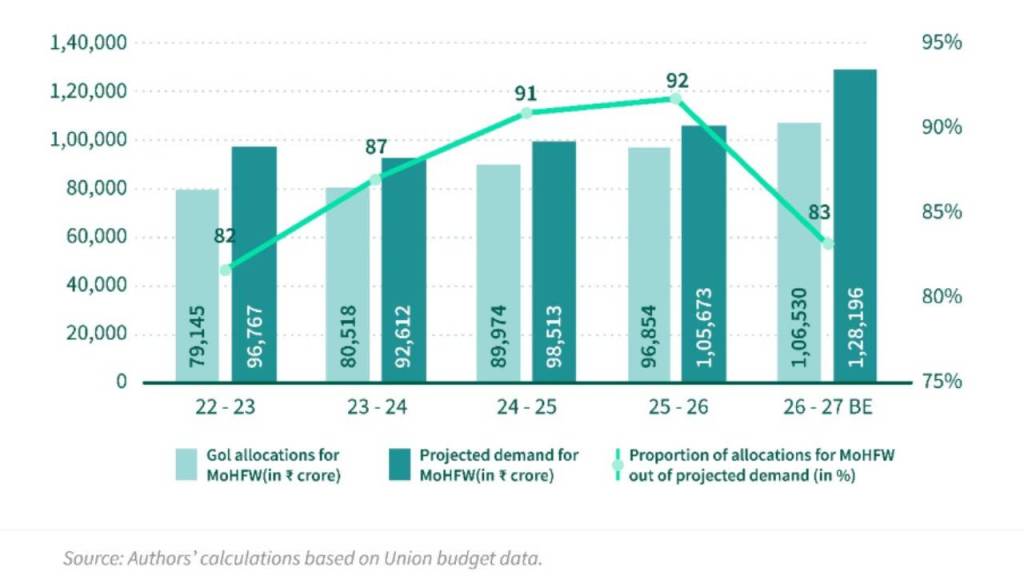
Over the past five years, allocations to the MoHFW have been much lower than the requirement projected by the Ministry. For instance, in FY 2026-27, the MoHFW has been allocated only 83% of its projected demand. Resource constraints may limit the Ministry’s ability to expand and strengthen its health programmes.
As of 8 March 2026, approximately 88% of the RE had been spent, which means that almost 1/8th of the total allocation for that year (₹11,360 crore) may be spent only in the last twenty days of the financial year.
- High utilisation of funds suggests spending capacity
Despite receiving less than requested, the Ministry has generally utilised the funds allocated to it. In both FY 2023-24 and FY 2024-25, spending exceeded the REs. High utilisation indicates that the Ministry is spending the resources made available to it. Taken together with the persistent gap between projected requirements and allocations, these trends suggest that under-allocation is the more important constraint.
However, at the same time, spending may not be even throughout the year. As of 8 March 2026, approximately 88% of the RE had been spent, which means that almost 1/8th of the total allocation for that year (₹11,360 crore) may be spent only in the last twenty days of the financial year.

A closer look at the DoHFW: where does the money go?
As discussed earlier, the Ministry’s budget is divided between the DoHFW and DHR. The DoHFW accounts for the majority of expenditure, receiving around 95% of total allocations across all years. The department’s expenditure can be grouped into four broad components, each reflecting a different way in which the union government finances health:
- Establishment Expenditure covers the costs of maintaining and operating government offices and institutions.
- Central Sector Schemes (CSs) are formulated and fully funded, designed, planned, and implemented by the central government, based on subjects from the Union List.
- Centrally Sponsored Schemes (CSSs), such as the National Health Mission (NHM), are implemented by state governments but largely funded by the GoI, with a specified contribution from the states; for larger states the fund-sharing ratio is 60:40, while for North-Eastern and hilly states it is 90:10.
- Finally, Other Central Sector Expenditure consists of centrally funded and implemented initiatives, including projects managed by autonomous bodies and central agencies, and spending on statutory bodies and public sector undertakings.
- Centrally Sponsored Schemes dominate, but direct central spending is rising
Across these components, Centrally Sponsored Schemes consistently form the largest share of the DoHFW’s budget. These schemes, which are implemented by states but largely financed by the union government, have accounted for between 54% and 58% of the department’s allocations in every year since FY 22-23, and stand at about 54% in the FY 26-27 BEs. Other Central Sector Expenditure forms the next-largest block, having grown from around 21% in FY 22-23 to roughly 29% in FY 26-27. Central Sector Schemes and Establishment Expenditure make up the remaining share, at close to 8% each in the latest year. The figure below shows how these shares have evolved over time.
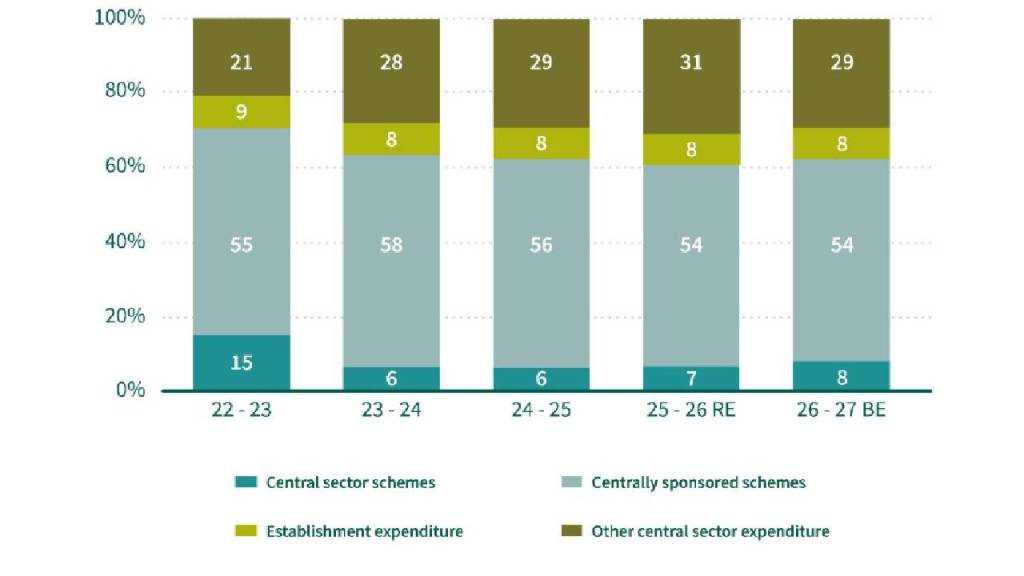
The single largest of the Centrally Sponsored Schemes is the National Health Mission (in FY 2026-27, allocations to the scheme constituted 41% of the total allocations to the DoHFW), the Union government’s flagship scheme to achieve universal access to equitable, affordable, and quality healthcare by strengthening health systems and capacities.
- The balance is tilting towards fully-funded central schemes
Taken over a longer period, the composition of the DoHFW’s budget shows a gradual shift. The combined share of Central Sector Schemes and Other Central Sector Expenditure, the components that the union government both funds and implements directly, has risen, while the share of Centrally Sponsored Schemes, which are shared with and delivered by states, has declined. This gives the centre greater direct control over how health funds are used, but it also means that a marginally smaller share of the DoHFW’s budget now flows through programmes that states design and run.
Conclusion and key takeaways
- Health is constitutionally a state subject, yet the union government sets national priorities and finances most major health programmes, so the union budget is central to how health services are shaped and delivered.
- The MoHFW is the nodal ministry, with the DoHFW accounting for the overwhelming majority of spending and implementation, and the DHR playing a smaller, research-focused role.
- Public health spending has risen over the past decade but remains well short of the National Health Policy 2017 target of 2.5% of GDP, standing at about 1.7% in the FY 2024-25 REs. The MoHFW’s own spending has stayed broadly flat at around 0.27% of GDP.
- The Ministry consistently receives less than it asks for, only 83% of its projected demand in FY 26-27, even as it utilises almost all of what it is given. This suggests under-allocation, rather than an inability to spend.
- Within the DoHFW, Centrally Sponsored Schemes remain the largest component, but the budget is gradually shifting towards schemes that the union government funds and implements directly.
- The single largest of these Centrally Sponsored Schemes is the National Health Mission. As India’s flagship health programme, it is where much of the union government’s health spending ultimately reaches states and citizens.
Subscribe to stay connected
We will send you a monthly newsletter listing all the articles that were published in the month.
This blog provides a broad overview of health financing and expenditure trends. For a comprehensive analysis of the Ministry of Health and Family Welfare’s budget, please see our detailed Budget Insight. The next blog in this series takes a closer look at the NHM, how it is structured, how it is financed, and what recent budget trends reveal about India’s most important health programme.
- Population control and family planning falls under the concurrent list, allowing both the union and states to legislate on them.
- Education institutions, including those for medical education falls under the union list.