




Background
Poor nutrition during the first 1,000 days of life has long-term ramifications on the health and well-being of individuals. Undernutrition can lead to fatalities among children under five. Early childhood nutritional deficits cause stunting and wasting, significantly impairing physical and cognitive development. This permanently alters brain development, leading to long-term reductions in educational attainment, diminished physical work capacity, and poor performance across all developmental metrics. Studies show this can decrease adult earnings by 20%, effectively creating an intergenerational cycle of poverty.
Research shows that poor maternal nutrition during pregnancy leads to
- Small for gestational age (SGA) babies
Poor nutrition during first 2 years of life causes:
- Stunting (low height-for-age), wasting (low weight-for-height) and underweight (low weight-for-age) in children.
- Impaired cognitive development
- Impaired Physical development
- Reduced academic performance
- Poor earning capacities through life
- Decreased maternal reproductive outcomes causing neonatal deaths (17 deaths /1000 Live births)
- Increased risk of chronic diseases such as diabetes and hypertension in adulthood
- Decreased longevity
- Intergenerational poverty cycle
India continues to face high levels of child malnutrition. National surveys show that a significant proportion of children under five are stunted, wasted, or underweight. Concurrently, urbanization and globalization have increased the availability and consumption of cheap, ultra-processed foods (UPF), even in low-income settlements. This creates a “double burden” of malnutrition—persistent undernutrition alongside rising exposure to unhealthy processed foods. Some research indicates a potential 15% increase in cancer risk associated with these dietary patterns.
Project objectives and methodology
The First 1,000 Days project by PUKAR was designed to understand and address maternal and child malnutrition in Mandala (M-East Ward), Mumbai, an informal settlement. The project utilized a Community-Based Participatory Action Research (CBPAR) approach, training local youth to execute the initiative.
This project aimed to enhance nutritional awareness among young women, as well as pregnant and lactating mothers, regarding the criticality of the first thousand days — from conception till the second birthday —to enable increased survival, better cognitive and physical development, and improved future earning capacity.
Partners for Urban Knowledge Action and Research, (PUKAR), based in Global South, is an independent research collective and world class incubator for producing knowledge, ideas, and innovations about global cities and communities. PUKAR believes that in a young, diverse, and pluralistic country like India where a large population faces multidimensional poverty, accepting, encouraging and respecting multiple epistemologies of knowledge, can contribute richly to urbanization and governance processes. PUKAR is anchored in the value of Community Based Participatory Action Research (CBPAR) as a powerful and ethical instrument for knowledge production by marginalized youth who create evidence-based actions for transforming themselves and their communities.
PUKAR, which has worked in Mandala for over a decade, observed increasing consumption of packaged foods among young children, alongside visible signs of undernutrition. These observations led to the development of this project.
The project was conducted among people living in slums, largely migrant families in Mandala. The community has limited access to sanitation and water, low literacy levels, economic instability, and gendered social norms affecting women’s autonomy.
Participants in the study in the initial planning included:
- 100+ pregnant or lactating women willing to participate through 24 months
- 100 infants aged 0–24 months
- 200 children aged 2–6 years
- 100 young women (16+ years)
However, as the study progresses and the word spread, we ended up accepting more children, since denying them entry was not ethical. Hence the ultimate numbers were higher (507) than we planned.
Three young women from the community were trained as Barefoot Researchers (BRs). They were trained in all key areas of the project.
A community census identified eligible participants who were residents of Mandala and were enrolled with informed consent. Baseline and endline surveys were conducted with the mothers.
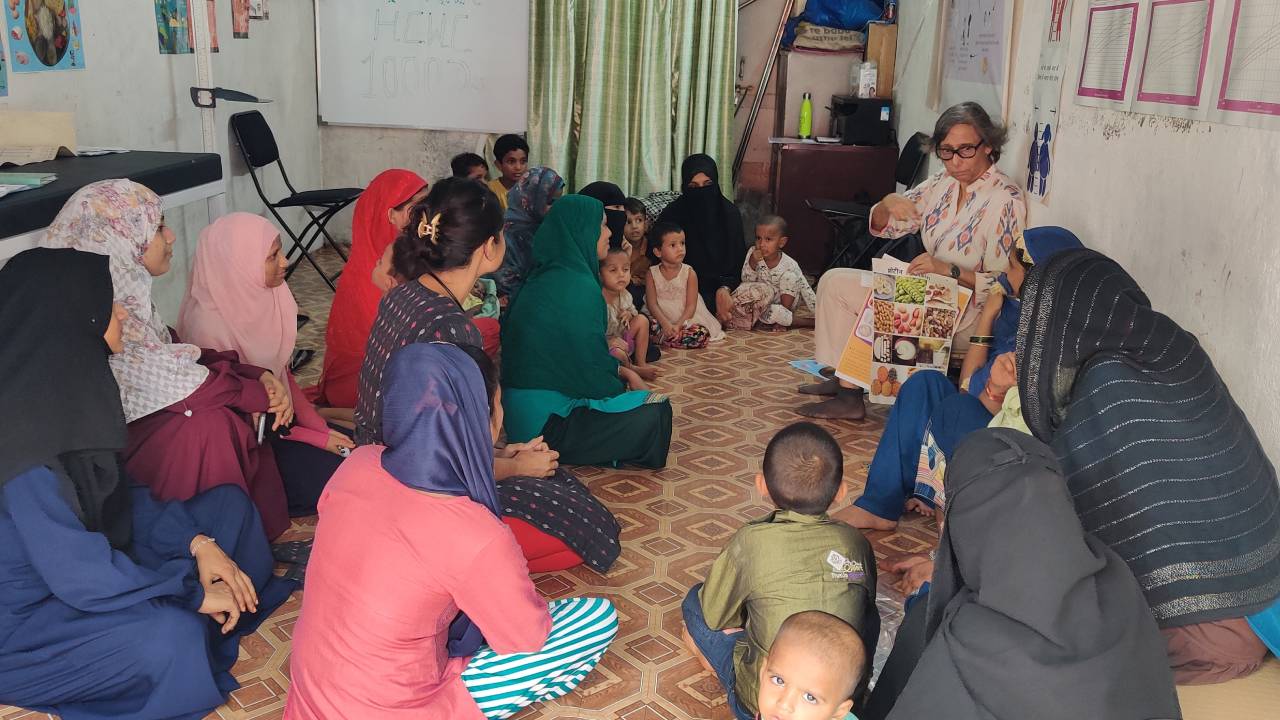
Pregnant women, young mothers, children, and adolescent girls were enrolled. Children were divided into 24 groups (10–15 children each). Mothers brought their enrolled children to the centre every two months for measurements while they attended educational sessions.
Growth Monitoring
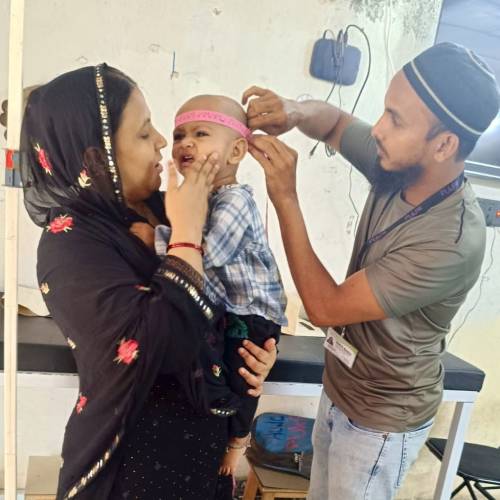
Anthropometric measurements were taken every two months for 18 months (9 rounds) for growth monitoring of the children. Data were plotted on WHO growth charts. Copies of these growth charts were shared with mothers.
- Height
- Weight
- Head circumference (for children under 2 years)
Baseline and endline surveys
Project activities included
- Surveys assessed food habits, breastfeeding practices, socio-economic conditions, and UPF expenditure
- Focus group discussions
- Screening of Videos, Documentaries
- Discussions around pictorials depicting “Poshan Aahar”
Topics covered during these sessions included:
- Breastfeeding techniques & Frequency
- Complementary feeding starting at 6 months
- Poshan Aahar
- Nutrition diversity
- Risks of ultra-processed foods
- Menstrual Health and Reproductive health including anaemia
Attendance of women at FGDs, however, was often irregular.
Baseline Findings
A. Young women / Adolescent girls: Among 120 adolescent girls surveyed:
- 92.5% used sanitary pads.
- 84.2% consumed outside food.
- Only 53.3% were aware of anaemia.
- 50.8% consumed fruits daily.
Smartphone ownership was high (85.8%).
Many women confessed that they were told not to gain too much weight so that the baby will remains small and could be delivered vaginally, thus avoiding a need for C-Section for which the funds were not available.
B. Pregnant women: Among 43 pregnant women:
- 20.9% had no formal education.
- 83.7% were registered at hospitals.
- 86% attended regular antenatal checkups.
- 97.3% were prescribed medicines; 91.7% reported taking them.
- 95.3% acknowledged the importance of good nutrition during pregnancy. This acknowledgement did not translate into actually better nutrition for them.
Despite high institutional engagement, traditional beliefs and taboos around pregnancy, food intake during pregnancy and postpartum practices remained strong.
Many women confessed that they were told not to gain too much weight so that the baby will remains small and could be delivered vaginally, thus avoiding a need for C-Section for which the funds were not available.
C. Mothers of children (0–6 Years): Among 54 mothers who were present for all 9 rounds, the End Line survey showed
- 73.3% initiated breastfeeding within 2 hours
- 29% gave outside milk in the first six months as were told
- 85.1% started complementary feeding after learning its importance
- 78.5% fed children shop-bought foods
- 45.6% reported illness in their child in the last month
- 90.3% reported full immunization
Growth monitoring outcomes
A total of 507 children were enrolled. Due to migration and inconsistent attendance:
- 41% were lost to follow-up
- 59% remained in the study
- Only 54 children attended all 9 rounds
Despite this limitation, positive changes were observed.
Children Present in All 9 Rounds (N=54)
- Stunting reduced from 35.2% to 31.5%.
- Wasting reduced from 13% to 5.6%.
- Underweight reduced from 26% to 20.4%.
Children Aged 2–6 Years (N=180, 1st and 9th Round)
- Severe stunting reduced from 10.6% to 3.9%.
- Severe wasting reduced from 1.1% to 0%.
- Severe underweight reduced from 6.7% to 5%.
This indicates substantial improvement in severe malnutrition among older children.
Children Aged 0–2 Years (N=118)
- Severe stunting increased from 4.3% to 12.9%.
- Wasting reduced from 6.8% to 0.9%.
- Underweight remained unchanged.
The increase in stunting among infants may be due to repeated infections, diarrheal illnesses, and medication affecting nutritional absorption during early life. Many researchers have shown similar findings related to increased stunting in first 2 years that improves in the next 3 years.
Dietary Diversity and UPF Spending
- Dietary Diversity Score increased from 2.76 to 3.67.
- Average money spent on UPF reduced from ₹30.17 to ₹9.85.
These findings demonstrate improved diet quality and reduced dependency on ultra-processed foods with frequent counselling and monitoring.

Baseline predictors
- Maternal height significantly predicted short stature
- Gender influenced underweight and wasting.
- Delayed complementary feeding negatively affected growth.
Endline predictors
- Maternal age became positively associated with linear growth.
- Timely complementary feeding improved weight-for-age outcomes.
The consistent role of maternal height highlights the intergenerational transmission of malnutrition.
Randomized controlled trial (RCT) on UPF
Each Barefoot Researcher was allotted 6-7 households for intervention and counselling the mother every third day, and to collect information about expenditure for the previous day on UPF. To examine spending patterns on ultra-processed foods, an RCT was conducted with 40 children (2–5 years), comprising 20 in the intervention group and 20 in the control group, over a period of 2 months.
The intervention group had home visits every 3 days, nutrition counselling, recording of daily UPF expenditure, encouragement of home-cooked food, and eggs provided at the beginning and end.

The intervention group showed a drastic reduction in money spent on UPF, while the control group remained largely unchanged. Meal frequency also increased slightly in the intervention group. This suggests that frequent counselling and monitoring can influence dietary spending behaviour.
Outcomes among Adolescent Girls
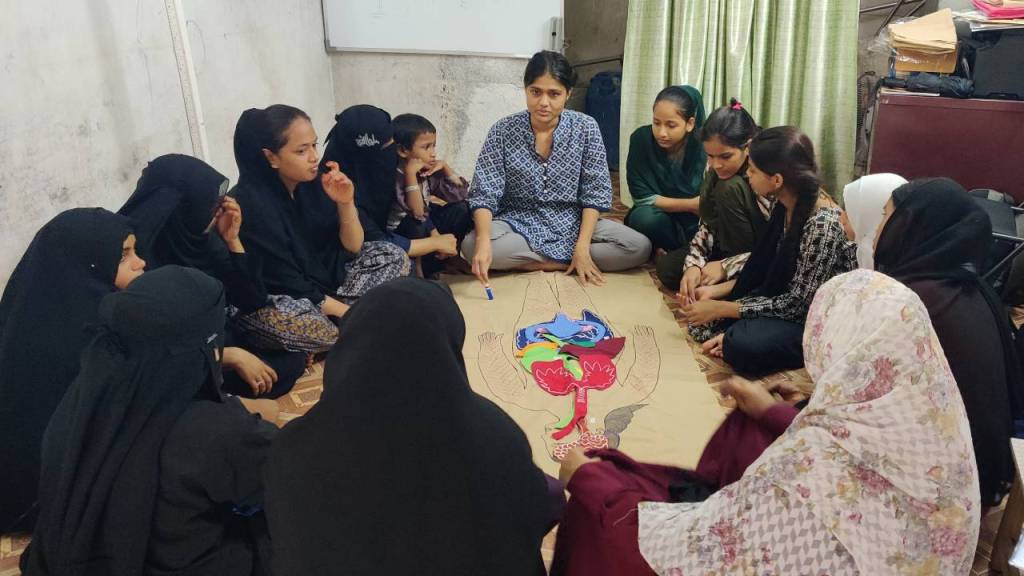
After nine sessions on puberty, menstrual health, reproductive health, nutrition and importance of physical exercise we found:
- Pad usage increased from 92.21% to 96.10%.
- Anaemia awareness increased from 54.55% to 90.91% with improvement in diet.
- UPF consumption reduced significantly.
- Average cost spent on UPF reduced from ₹228.51 to ₹108.12.
Girls reported greater confidence in discussing reproductive health and understanding the importance of delaying pregnancy. However, dietary diversity scores slightly decreased, indicating that awareness does not always immediately translate into improved diet quality.
Challenges
The project faced several difficulties, such as:
- High attrition (41%).
- Irregular attendance at sessions.
- Migration during festivals.
- Social desirability bias in breastfeeding responses.
- Inaccurate birth weight reporting by hospitals.
- Limited involvement of fathers.
- RCT shortened to two months.
Subscribe to stay connected
We will send you a monthly newsletter listing all the articles that were published in the month.
Overall Findings
The project demonstrated:
- Reduction in wasting and underweight.
- Reduction in severe stunting among older children.
- Improved dietary diversity.
- Significant reduction in UPF spending.
- Increased awareness among adolescent girls and mothers.
However:
- Stunting increased among infants under two.
- Behavioural change required sustained effort.
- Social Determinants of Health (poverty, housing, WASH, attractive and affordable marketing of UPF, gender norms, social desirability) remained strong influences.
Conclusion
The First 1000 Days project shows that community-based awareness, regular growth monitoring, and repeated counselling can improve child nutrition outcomes in marginalized urban settlements.
The strongest finding is the intergenerational nature of malnutrition. Maternal height and health significantly influence child growth outcomes, underscoring the need to invest in adolescent girls and maternal nutrition.
While improvements were observed — especially in reducing wasting and severe malnutrition — the vulnerability of children under two remains a concern. Early infections and environmental factors continue to affect linear growth.
The reduction in spending on ultra-processed foods through counselling demonstrates that behaviour can change when supported consistently.
Overall, the report confirms that the first 1000 days are critical, but sustained engagement beyond infancy is necessary to break the cycle of malnutrition and improve long-term health outcomes.