




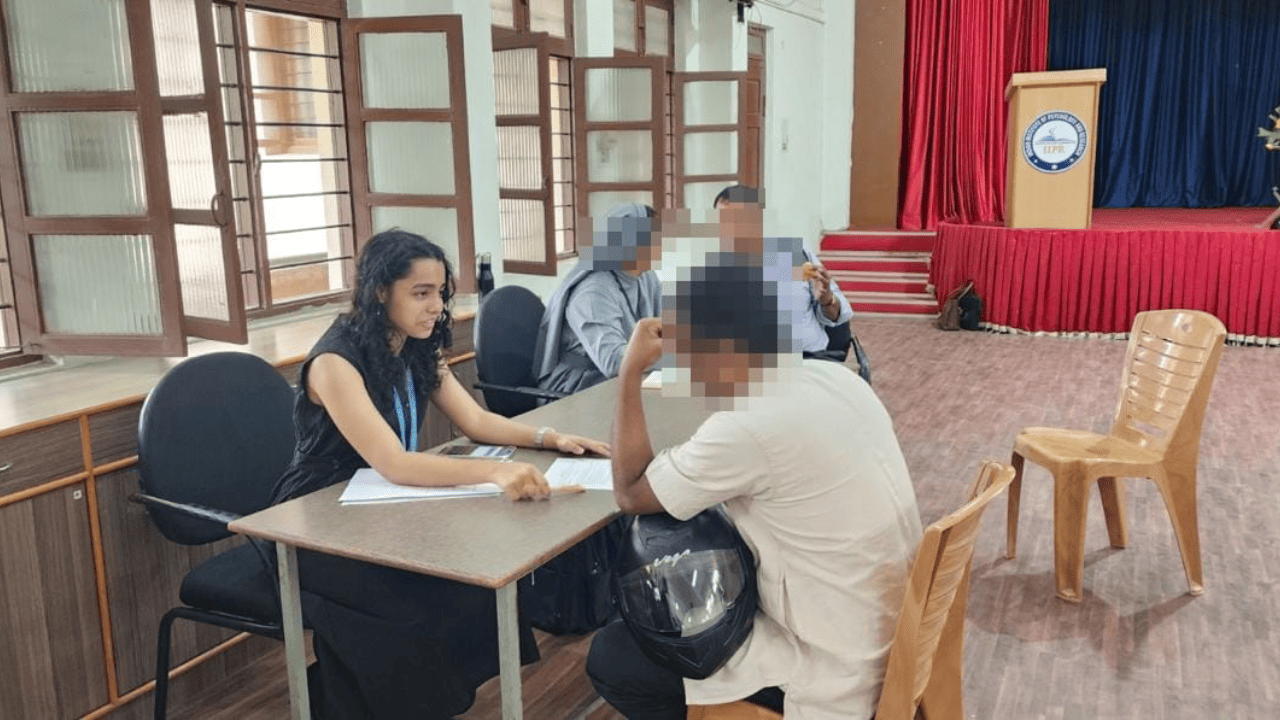
That July morning, I arrived at the local health camp in a formal dress and boots, eager to set myself apart from the other student volunteers, to look more like a researcher than a helper. A handful of us medical students had been summoned primarily as Hindi speakers to translate patient complaints for the attending doctors. I wasn’t there solely to help. I was also a student researcher, with my own agenda: conducting pilot interviews for my study among patients already receiving treatment for conditions like diabetes and hypertension.
At the camp hall, I slid between groups of waiting doctors, positioning myself with the polished eagerness of an aspiring academic. For the next four hours, I floated through the crowd, talking to patients about their beliefs, practices, and experiences within India’s healthcare landscape.
I listened with an acute sense of my own privilege, painfully aware of the chance lottery of birth that separated my life from theirs.
What followed was an overwhelming immersion into stories heavy with exhaustion. Women carried the weight of broken families, financial struggles, ailing loved ones, and abusive partners; they laid bare realities I could barely fathom listening to, let alone living.
Men spoke of the quiet anxiety of being default breadwinners, describing how they routinely ignored physical ailments or sought quick fixes to avoid missing a single day’s wage or “inconveniencing” their families. Their stories made me realise how much of their daily distress had to be compartmentalised simply to keep going. Their reluctance to articulate these anxieties plainly also made me wonder how strongly rigid expectations of masculinity shaped the ways they experienced and expressed distress.
I listened with an acute sense of my own privilege, painfully aware of the chance lottery of birth that separated my life from theirs. I failed to remain emotionally “professional”, needing a breather after each conversation that got a little too heavy.
By hour four, drained from bearing witness to so much unspoken distress, I decided it was time to finally do some actual volunteer work.
I moved to the screening desk, where a line of people waited to complete a questionnaire. Relieved to swap the heavy emotional demand of in-depth interviewing for simple administrative data collection, I sat down next to another volunteer, opened a fresh form, and slipped into a comfortably robotic rhythm.
How do you ask a migrant labourer, working 15-hour days away from home and navigating financial insecurity, to reduce something as complicated as distress to a frequency—“sometimes”, “often”, “very often”—as if it could be isolated from the circumstances that had become her everyday reality?
My first respondent was a chirpy woman in her 50s who had migrated all the way from Assam. She answered questions about her age, origin, and general health with great enthusiasm. But as the questionnaire shifted to household demographics and living conditions, I sensed a shift. The enthusiasm gave way to a guarded, hesitant impatience. I kept my face blank and my tone even, trying to project neutrality rather than judgment.
Then, I turned the page and hit the mental health screening section.
The form required me to administer a standardised 2 item screening tool for psychological distress, commonly administered by trained personnel, asking how often in the past two weeks the respondent had felt ‘down, depressed, or hopeless.’
These categories are not meaningless; they reveal patterns that individual stories alone cannot reveal. The problem begins when the number becomes easier to interpret than the life it represents.
I froze.
I am a Mumbaikar; Hindi is my third language, spoken with an unmistakable accent. How was I supposed to translate clinical terms like “depression” or “hopelessness” into a rapid-fire frequency scale for a woman from Assam standing in a noisy corridor? How do you ask a migrant labourer, working 15-hour days away from home and navigating financial insecurity, to reduce something as complicated as distress to a frequency—“sometimes”, “often”, “very often”—as if it could be isolated from the circumstances that had become her everyday reality?
Perhaps this is one of the quiet privileges of public health: the ability to turn structural problems into individual variables. Poverty becomes socioeconomic status. Migration becomes place of residence. Exhaustion becomes a frequency of psychological distress. A life shaped by insecurity becomes a row in a spreadsheet. These categories are not meaningless; they reveal patterns that individual stories alone cannot reveal. The problem begins when the number becomes easier to interpret than the life it represents.
Panicking under the pressure of the waiting crowd, I felt my academic training evaporate. I dropped the clinical script entirely and blurted out the only translation I could construct in the chaos:
“Kya aap dukhi ho?” (Are you sad?)
For five agonizing seconds, the entire world seemed to fall silent.
She looked me dead in the eye. She didn’t just hear the question; I could practically see her registering the sheer, awkward panic radiating off me. And then, the tension snapped—we both burst out laughing.
Trying to salvage whatever was left of my professional composure, I mumbled an apology, hiding behind bureaucratic duty: “I’m just asking because I have to fill this form.”
She smiled, offered a gentle nod of cooperation, and simply replied: “Yeah, sometimes. I mean, who isn’t?”
“Who isn’t?”
Cities like Bengaluru and Mumbai may offer economic opportunity while simultaneously subjecting migrants to social isolation, environmental stressors and weakened community ties.
In two words, she dismantled the objective of our exercise. The question was designed to isolate specific experiences of psychological distress and translate them into a frequency. But sitting in a camp in Bengaluru, talking to a migrant woman from Assam, I found myself wondering what exactly I was measuring. Her distress did not exist neatly apart from the financial insecurity, migration, family responsibilities, and uncertainty that shaped her daily life. How much meaning could a frequency carry once it had been detached from the circumstances that produced it?
Her situation also made me think about the vulnerabilities that are imposed onto people already living with uncertainty. Cities like Bengaluru and Mumbai may offer economic opportunity while simultaneously subjecting migrants to social isolation, environmental stressors and weakened community ties [1]. I began to wonder how often mental-health services/support account for these overlapping realities, rather than treating them as separate variables.
Later, reading about mental health in India, I found this tension reflected in the literature: social and material conditions shape not only the experience of distress, but also the ways it is understood and addressed [1,2]. Ramani Atkuri’s Staying Alive similarly explores how poverty, geography and social disadvantage become entangled with illness and access to care.
Yet this does not make measurement the enemy. Public health depends on metrics precisely because they allow complex human experiences to be quantified, compared and analysed and, ultimately, to inform policy and drive change. The danger lies in mistaking the measurement for the thing itself: in allowing a number to become easier to interpret than the life it represents.
But that distinction felt rather different when I was sitting across from her. A woman who had spent most of her day on her feet was being asked to stand in a public queue, unpack her distress for a stranger with a Mumbai accent, and quantify it on command.
Forced to bridge that absurd divide, I did what field researchers rarely admit to doing in their methodology sections: I improvised.
Here was a woman already negotiating the demands of work, migration, and financial insecurity, being asked to make her distress legible to an institution in a few predetermined categories.
I looked at the paper, looked at her, and tried to translate complicated human experiences into a frequency based on a fleeting interaction that I knew could never capture it.
The encounter stayed with me. I wondered how people more experienced than me handled this discomfort. Did they learn to translate these questions into increasingly comfortable formats? Did they simply become better at asking them? Or did they sometimes decide that not asking was easier?
I found that last possibility particularly unsettling.
In a country with approximately 41 million migrants [4], not asking such questions carried its own violence of omission: what remained unasked could remain unseen, unrecorded, and perhaps institutionally irrelevant. Yet asking was not innocent either. Here was a woman already negotiating the demands of work, migration, and financial insecurity, being asked to make her distress legible to an institution in a few predetermined categories. If omission could make suffering invisible, could asking, in the wrong circumstances, become its own form of indignity?
Perhaps skipping the question was not simply laziness or poor methodology, but an improvised form of mutual protection. Field workers might spare the respondent the burden of having to make her distress legible to an institution, but at the cost of making that distress disappear from the record. The uncomfortable truth was that neither choice was neutral.
In that crowded hall, ticking a convenient box became a way of granting the people in that queue something the metric had failed to account for: the right to move on with their day without having to perform or relive their suffering for a clipboard.
I came to the camp wearing boots and playing the role of a clinical investigator. I left wondering whether the most important thing I had measured that day was not a score at all, but the distance between the question we ask and the life of the person answering it.
Subscribe to stay connected
We will send you a monthly newsletter listing all the articles that were published in the month.

Perhaps that is one of the uncomfortable truths of public health: we need numbers to see patterns, but we must never forget the lives that become numbers in the first place. At that crowded camp, the most honest data point was not a ticked box; it was a woman’s laugh and a two-word answer: “Who isn’t?”
References
- Nandish M, Pruthi SR, Dhaliwal AS. Social determinants of mental health in India: Beyond hospitals and pills. Ann Indian Psychiatry. 2026. doi: 10.4103/aip.aip_25_26.pubmed.ncbi.nlm.nih
- Chakrapani V, Bharat S. Mental health in India: Sociocultural dimensions, policies and programs – An introduction to the India Series. SSM Ment Health. 2023;4:100277. doi: 10.1016/j.ssmmh.2023.100277.journals.sagepub
- Atkuri R. Staying Alive. Pan Macmillan India; 2024.
- Ministry of Labour & Employment, Government of India. Migration of Labour in the Country [Internet]. New Delhi: Press Information Bureau; 2023 Jul 20 [cited 2026 Aug 30]. Available from: https://www.pib.gov.in/PressReleasePage.aspx?PRID=1941077