





Does a Half-Day Workshop Reflect Your Life?
A month into the Master of Public Health programme at Azim Premji University, I received an email from a faculty member about a fun, joyful interpersonal workshop exploring social identities for public health learning. The announcement described it as an experiential exercise using worksheets, movement, and group sharing.
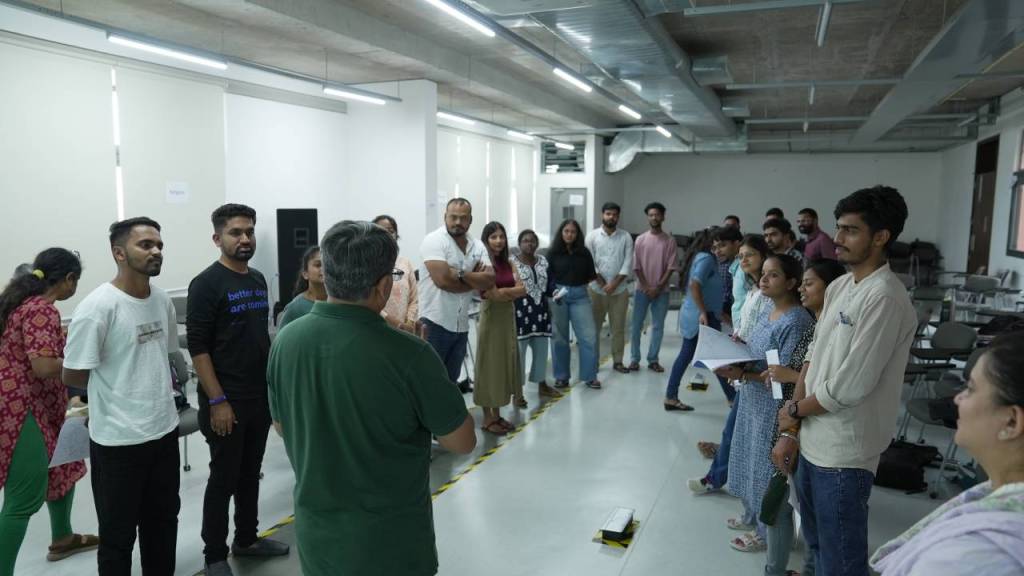
I arrived slightly late for the workshop and noticed my classmates sitting in a circle, surrounded by an outer circle of boards with words written on them. The moment I saw the first board with the word ‘caste’, I froze as my lived experiences flashed before my eyes. Finally, when my friend called out to me, I entered the room and sat down — my mind blank for 15 minutes. I heard nothing. I felt overwhelmed and empty, my heart heavy as I pondered a question in my mind: who am I?
A Wheel of Identities, an Unfilled Box, and the Breaking Moment
Each chair in the circle had a printed worksheet. I took mine hesitantly with shivering hands as I sat down. Each side featured a wheel of personal and social identities, with boxes to capture birth order, number of siblings, caste, class, gender, religion, language, ability, and education. Already pondering questions about myself, I entered another mental zone as I was asked to fill in the details on the wheels. Will a friend nearby see me filling in entries? How can I fill this box? What will my friend think about me once I write my caste? Will she speak to me again? Many questions raced through my mind, and yet the box remained unfilled.
You people are never ever able to complete school or a degree because Saraswati (the goddess of knowledge) does not visit your caste. And you are saying that you are going to become a doctor with a PhD?
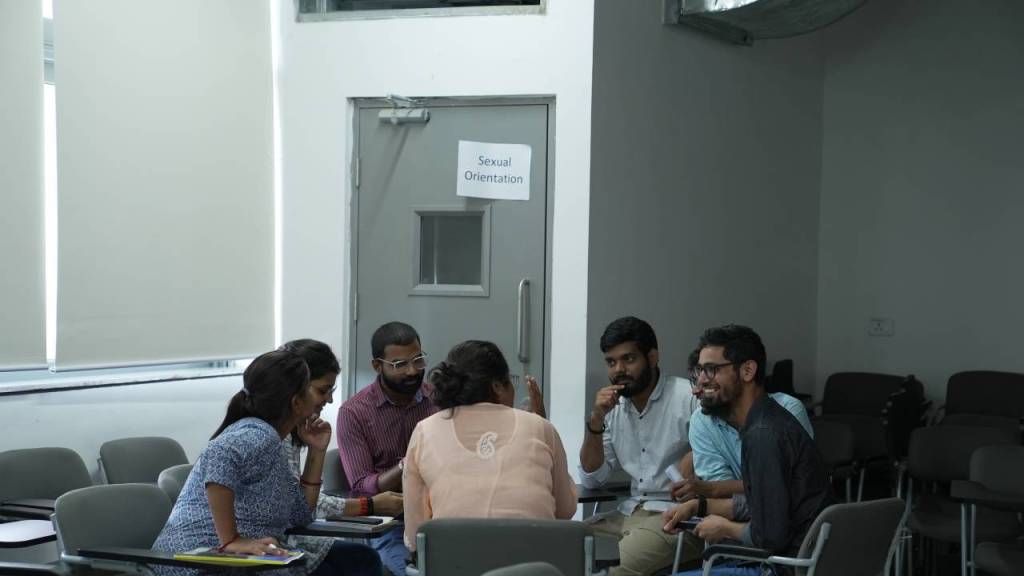
We were then asked to form small breakout groups of our choice to share — not about the entry in the boxes but our experiences of writing about our identities. Because I felt comfortable with my group members, I felt confident sharing my thoughts. I gathered up my courage and started speaking in a low voice. I found it hard to pronounce my words and stammered as my voice broke; and tears spilled out of my eyes unbidden. It was not my fault. My eyes were simply responding to the emotions welling up inside.
Different Lenses on the Same Image and Deep Unhealed Wounds
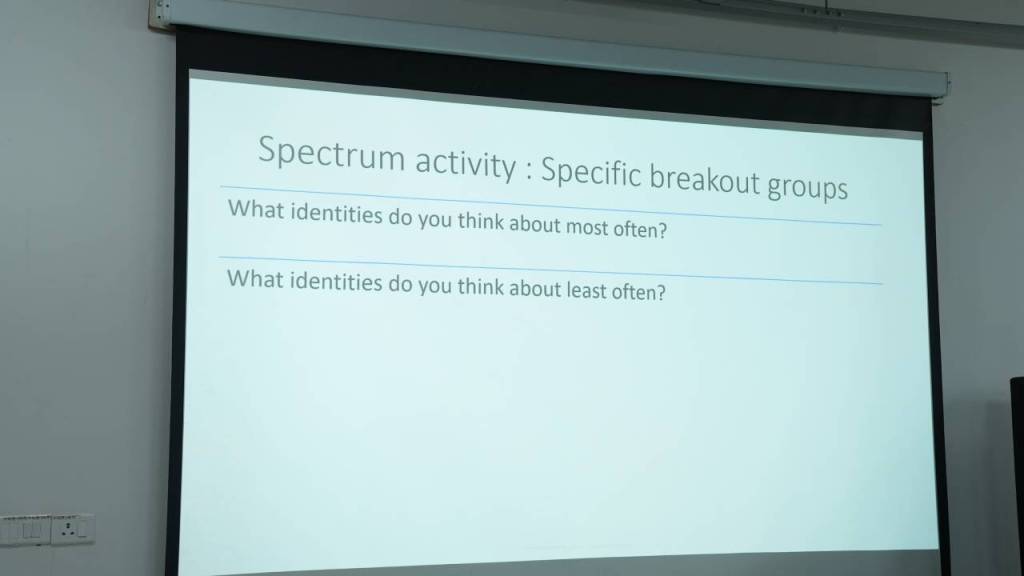
Filling in just ‘birth order’ and ‘number of siblings’ on the personal identity wheel was itself quite difficult. People often think I’m lucky to be an only child, but only I know how lonely and hard it was. Since 7th standard, I consciously decided to stay in the hostel to be with friends. In the 12th grade, I had a dream that nobody would be there for me after my parents, and I would have to struggle all alone in this world. Since then, I’ve kept an emotional distance from everyone, even my parents. While others have siblings, no one is there for me, which is why education is so important for me — I told my friends.
When I saw the word “caste” on the board and on my paper, certain painful scenes from my school and college days came rushing back.
In the school, when students in my class had shared their goals and ambitions, I had told the class proudly that I wanted to become a doctor and pursue a PhD. For little me, it was the biggest degree. One that no one from my village and community had ever earned. My class teacher had laughed at me and said, “You people are never ever able to complete school or a degree because Saraswati (the goddess of knowledge) does not visit your caste. And you are saying that you are going to become a doctor with a PhD? How is that even possible? In your caste, a girl in her 20s, will already be with her second child“. Everyone in my class, including my friends, had laughed at me.
Even my close college friends never introduced me to their parents, even after five and a half years of my course. I ended my friendship with one of my best friends after he told me that if he took me to his home, then his grandmother would beat him with a slipper.
Later, I proved him wrong with 96% marks and admission to a naturopathy medical college. He apologized for his words when I saw him again at school. I simply said, “Thank you—because of your words, I am here.” I still haven’t been able to forgive him.
Alone in the Group Through Incomplete Dialogues and Strong Denials
In college, I finally felt a sense of belonging as everyone proudly said, “I am going to become a doctor.” I believed that nobody would say anything about my caste now. But the real world didn’t let my happiness last long. Even my close college friends never introduced me to their parents, even after five and a half years of my course. I ended my friendship with one of my best friends after he told me that if he ever took me to his home, his grandmother would beat him with a slipper.
“You have a reserved category seat, so why do you have to worry?” At that moment, I decided to earn my place solely through my merit and my knowledge, not my caste.
Although on the surface, people were close to me — they borrowed my things, shared my food and everything seemed fine — their actions frequently showed underlying distance.
Whenever people asked what my caste was, I was terrified of telling the truth and would claim my parents had an intercaste marriage. Once, I left my friend’s home almost immediately upon arrival when her father asked about my caste just as I was about to take my first bite of rice. In college, just like in my school, I was stunned to overhear teachers and professors discussing how marks are connected to caste, and how even patients choose doctors by caste. My education loan was initially denied because I was from a particular village and a particular caste.
In my final year, when we were discussing our MD examination, one of my best friends told me, “You have a reserved category seat, so why do you have to worry?” At that moment, I decided to earn my place solely through my merit and my knowledge, not my caste.
But then I thought, “if I screamed and cried only within these four walls, no one would hear me!” So, I decided to speak up in class, engage with my professor and classmates, and ultimately write this note.
Pain of Hiding Who I am
As I wrote this, I could not control my tears and pain. I have been constantly searching but haven’t found any answers. I’m not trying to hide my identity. But whenever I get a moment to say, “Yes, I am from this category”, I wish I could also shout to everyone, “How does it matter to you?”
Holding the worksheet and listening to others, I had assumed that once I became a doctor, this divide between ‘upper’ caste and ‘lower’ caste would no longer be there. But the social hierarchy told me otherwise. I am told that I am low, with the casual use of phrases like upper caste and lower caste here as well. What does “up” and “low” even mean? What makes some feel “upper” and others feel “lower”? In a circle full of chairs, how do I figure out which chair is for the upper and which one is for the lower? I felt like I was playing a game of musical chairs without knowing how much I needed to run. When can I reach my chair? Where is my chair? How can I reach that place called “Upper”?
In a well-ventilated hall, I felt suffocated. My heart felt crushed, and tears dropped on my worksheet. I left the workshop and cried a lot in my room. But then I thought, “if I screamed and cried only within these four walls, no one would hear me!” So, I decided to speak up in class, engage with my professor and classmates, and ultimately write this note.
A Long Way to Run Towards the Real Meaning of Identity
Some people wear their social identity proudly, while some others are forced to carry it like a weight crushing them. Let me conclude this with an analogy. Ten of my peers at the table are served varied, delicious food on their plates. I am the eleventh person at the same table, but my plate has only stale rice and onions. My ten peers are not hungry, so they waste their food by throwing it in the dustbin. What would I do as a hungry person? To those sitting on the privileged side of that table, I want to say: do not flaunt your pedigree, caste status, and inherited advantages when so many of us are still starved of basic dignity.
Equal Social Identity for Everyone: Lessons of a Public Health Student
This half-day workshop and the open discussions that followed in the class transformed my perspective and helped me view myself and the society around me differently. It gave me a broader perspective on how society imposes its prejudices on us, and prompted some important questions: Why does society pressure a 12-year-old girl to chase her chair? Why should there be chairs to begin with? Is something amiss in the society while I search for a missing part of me? Is my identity my individual choice or is it something society imposes on me? Why am I chasing a chair when there probably isn’t one? Why have I carried these painful experiences for so long? And yet, why am I so silent?
If a highly educated person like me could feel embarrassed about the tag that society has forced on me, and feel diffident and fearful of revealing myself to my peers, imagine how underprivileged communities might feel approaching the healthcare system?
This experience helped me move past the paralysing fear, “what if I write this in the box and my friend judges me for it”. I finally mustered the courage to share all my lived experiences with everyone, loudly. I can now tell others: this is me, and this is my community. This society has given me a social identity, although it is not literally who I am. I now feel more confident and free from all the baggage I have carried for so many years. Unlike previous experiences of suffocation and choking, I found Azim Premji University to be a ventilated space where I can breathe freely and express myself because my friends, faculty, and everyone around me see me as an equal person, not by the tag society gave me.
As public health students, we all learn from chapters and classes. But I learned the importance of equality through this workshop by connecting it to my life experiences. While I will continue to share my pain and struggles with peers to generate wider discussion on social inequality, I also hope to find more answers to the question, “Who am I?”
The experience also taught me an important lesson as an aspiring public health professional. If a highly educated person like me could feel embarrassed about the tag that society has forced on me, and feel diffident and fearful of revealing myself to my peers, imagine how underprivileged communities might feel approaching the healthcare system? A system that is resourced by people who carry their own prejudices and might treat them with disrespect? Maybe my honest sharing of my feelings may educate my classmates on the mental burden caste ‘inequalities’ place on communities? Maybe, inadvertently, I might have helped some of my peers become more empathetic professionals?
Lastly, as I acknowledge my privilege of being the first person from my village to receive higher education and the only student in my batch from my state, I also feel the need to lend a hand to others like me who are hungry, with stale rice and onions on their plates.